The Invisible Barrier of Language in Technology Education
When discussing bridging the digital divide in Pakistan, the conversation typically focuses on hardware and broad internet connectivity like the introduction of laptops, rural broadband, or subsidizing school infrastructure. While access remains a critical foundation, an often-overlooked factor creates an invisible, formidable wall against technological proficiency: language.
The overwhelming majority of advanced digital skills training, particularly in emerging disciplines like Artificial Intelligence (AI) and Machine Learning, is delivered almost exclusively in English. For a country where a significant subset of the population navigates daily life in Urdu and regional languages, this English-first approach immediately sidelines millions of capable individuals. The challenge isn't a lack of interest in understanding the technology that is transforming global industries—it's that the documentation, the tutorials, and the core conceptual explanations simply aren't accessible.
The Inception of Urdu AI
Observing this growing disparity from the ground floor in Balochistan, the Welfare Association for New Generation (WANG) recognized that the true democratization of technology must start with language. In early 2023, the foundation was laid for what would quickly become Urdu AI, built to remove the language barrier in technical education for Urdu speakers.
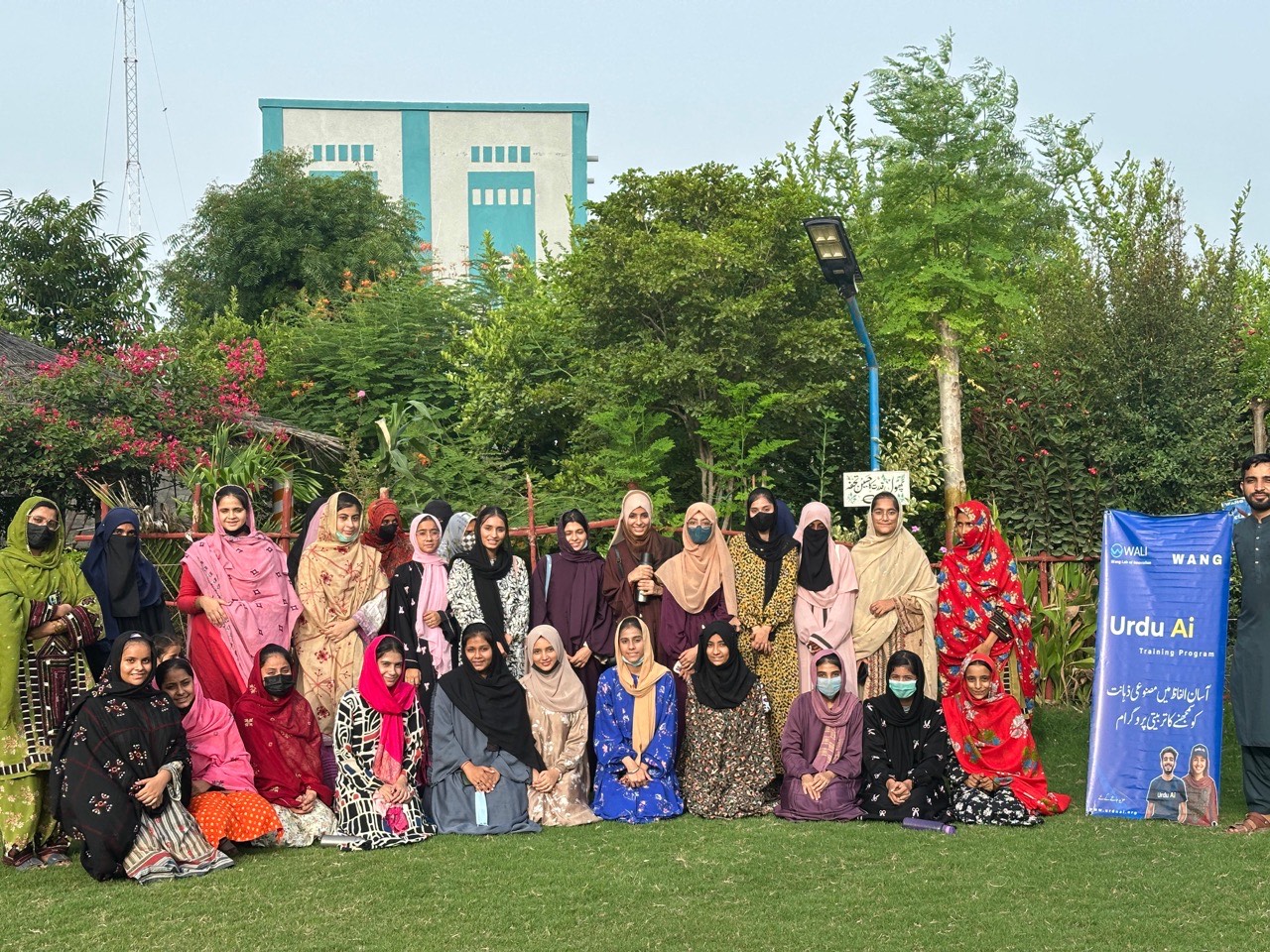
The vision behind Urdu AI was simple but bold: to break down complex AI concepts into accessible, clear Urdu, ensuring that the latest technological advancements were not confined to a privileged, English-speaking minority. Starting with basic digital literacy frameworks inside the physical WALI lab in Ahmed Abad Wang, Lasbela, the curriculum was uniquely designed not just to translate technical jargon, but to conceptually localize the material so it resonated with the cultural and practical realities of Pakistani youth.
Unprecedented Scale and Reach
What began as an localized initiative in Balochistan rapidly expanded, addressing a massive, unserved national hunger for accessible technical knowledge. Today, Urdu AI stands as Pakistan's largest free AI education platform.
The numbers reflect rapid growth: more than 1M+ learners have engaged through Urdu AI’s learning pathways, and the wider online community across WhatsApp, YouTube, Facebook, and the web is also above 1M+. The live impact dashboard reports 7,968+ participants and 248 trainings. Because high-speed internet is uneven nationally, Urdu AI uses a multi-platform strategy—WhatsApp communities, YouTube, Facebook groups, and the mobile app as one route among several.
For more specific details on the broader reach of WANG's programs, view the Impact page.
The Power of the Dost Facilitator Network
While digital scaling is vital, WANG's deep roots in community organizing mandated a hybrid approach to ensure high engagement and completion rates. Enter the Dost Facilitator Network.
Across 29 districts in Pakistan, 31 active "Dost" (friend) facilitators operate on the ground. These trained community members serve as local ambassadors and guides, establishing study circles, answering questions, and providing the crucial human element often missing in pure remote-learning environments. The Dost network ensures that Urdu AI isn't just an app on a phone, but a structured community movement.
Partner Backing and the Road Ahead
The massive adoption rate of Urdu AI has drawn leading partner support. With backing from Google.org and strategic partnerships facilitated through AVPN's AI Opportunity Fund, Urdu AI is equipped to scale further. Tying national content to district facilitators is exactly what our AI education in Pakistan page describes: the policy landscape is crowded with English-first and online-only assumptions, so Urdu-first delivery plus in-person trust is the approach that actually reaches first-time learners.
Every day, thousands of new learners log onto Urdu AI to understand ChatGPT, prompt engineering, and the fundamentals of machine learning—in their own language. By removing the friction of English proficiency from the learning curve, Urdu AI is proving that talent is ubiquitous, and when given the right tools in the right language, Pakistani youth are ready to lead the future.
Why a Lasbela field hub still anchors national scale
Urdu AI is a national platform, but it is not an abstraction built in a vacuum. WANG still stress-tests curriculum, facilitation norms, and safety culture from Ahmed Abad Wang in District Lasbela, where the WALI lab turns digital ideas into cohorts of real people with uneven connectivity. That loop—field frustration feeding product clarity—is what keeps the movement honest when grant narratives talk only about impressions and downloads.
Funders and corporate partners evaluating AI skilling in Pakistan should read the public numbers on Impact alongside this journal: reach and learners are defined differently, and both matter. When you are ready to underwrite a district batch, a Dost training round, or research on who is still left out after mass online campaigns, contact WANG with your outcome and timeline—we answer with field schedules, not just slide decks.