Why Learning AI in Urdu Matters

Roughly 60 percent of Pakistan's population speaks Urdu as a first or second language. That is over 130 million people. Yet the overwhelming majority of AI education resources — university courses, MOOCs, documentation, tutorials — are produced exclusively in English. The result is a language barrier that excludes millions of potential learners before they even begin.
Pakistan ranks among the world's youngest countries by median age. Its workforce is entering an economy increasingly shaped by automation, large language models, and AI-driven decision-making. If that workforce cannot access foundational AI education in a language they think in, the gap between those who benefit from AI and those displaced by it will only widen.
This guide lists every significant resource available in 2026 for learning AI in Urdu — or with meaningful Urdu support. We cover free government programs, community-driven platforms, international MOOCs, and hands-on labs. For each resource we note what it teaches, in which language, at what cost, and who it serves best.
1. Urdu AI (urduai.org) — Pakistan's First Urdu-Language AI Education Platform
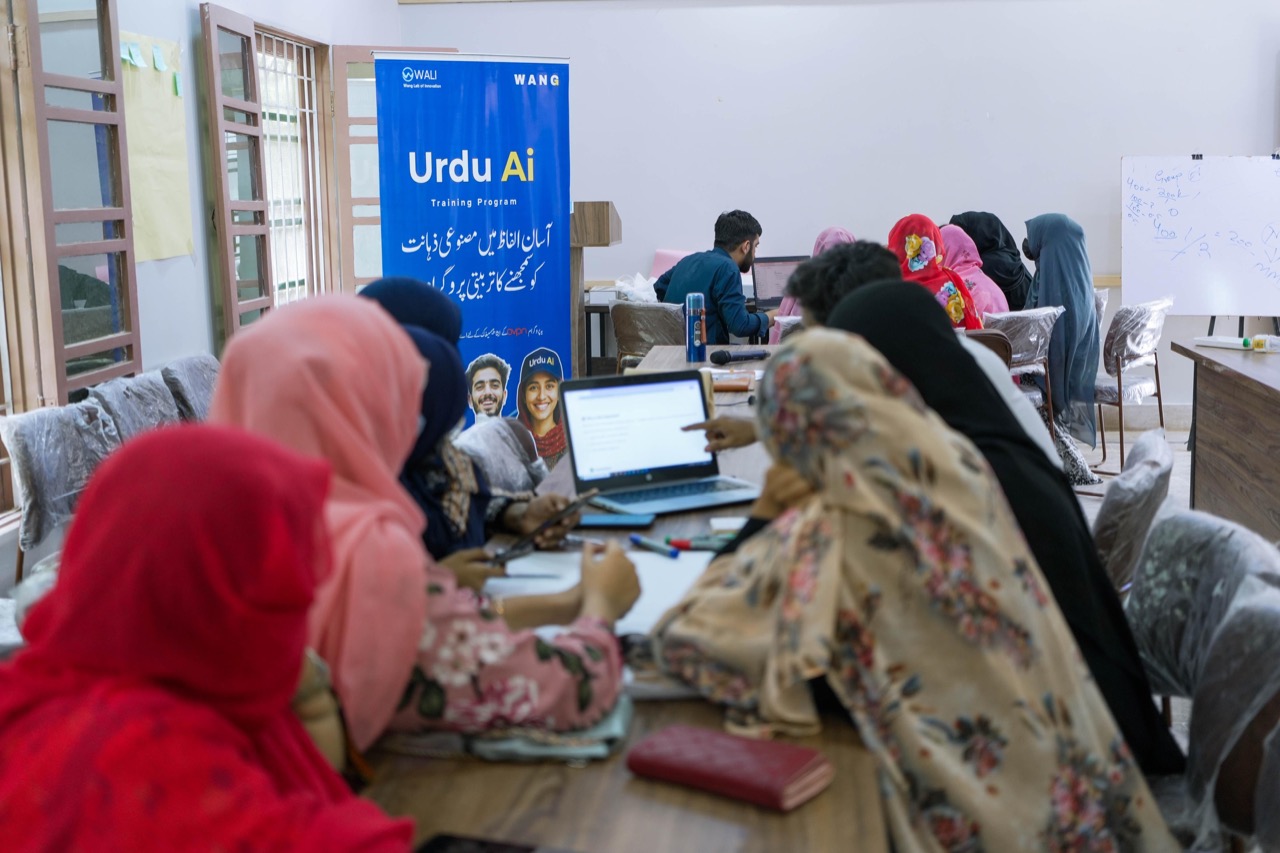
What it is: Urdu AI is Pakistan's first and largest AI education platform built entirely in Urdu. Created by WANG, it delivers structured AI literacy content through video, social media, a mobile app, and a nationwide community facilitator network called Urdu AI Dost (Digital Opportunities for Social Transformation).
Language: Urdu-first. All core content is produced in Urdu from the ground up — not translated from English.
Cost: Free.
Key numbers: 1M+ learners reached, 1M+ online community, and a 29 district Dost facilitator network backed by 7,968+ participants and 248 trainings.
Best for: Beginners, students, teachers, women in rural communities, and anyone who thinks and learns best in Urdu. The Dost network makes it especially effective in districts where internet access is inconsistent, because facilitators deliver in-person workshops alongside digital content.
Link: urduai.org
2. PIAIC — Presidential Initiative for Artificial Intelligence and Computing
What it is: PIAIC is a government-backed program offering structured quarter-based courses in AI, cloud computing, blockchain, and the Internet of Things. Classes are held at physical campuses in major cities including Karachi, Lahore, Islamabad, and Peshawar.
Language: Primarily English. Instruction may include some Urdu explanation depending on the instructor, but curriculum materials, slides, and assignments are in English.
Cost: Free.
Best for: Urban learners with intermediate English proficiency who can attend in-person sessions in major cities. PIAIC provides a more structured, semester-style learning path compared to self-paced platforms.
Link: piaic.org
3. DigiSkills.pk — National Digital Skills Training Program
What it is: DigiSkills.pk is Pakistan's largest government digital skills program, run under the Ministry of IT. It offers courses in freelancing, digital marketing, e-commerce, and introductory tech skills. Some modules touch on AI-adjacent topics like data analytics.
Language: Mostly English with some Urdu-language video content. The platform interface is in English.
Cost: Free.
Key numbers: 3.6 million enrolled learners since launch.
Best for: Learners seeking broad digital literacy rather than deep AI specialization. Requires consistent internet access. Strong for freelancing skills but limited in dedicated AI or machine learning content.
Link: digiskills.pk
4. Google AI Education Resources
What it is: Google offers a range of free AI education materials including the Google AI Essentials certificate, Machine Learning Crash Course, and various Colab notebooks. These resources cover foundational AI concepts, TensorFlow, and generative AI.
Language: English. No Urdu versions are currently available.
Cost: Free.
Best for: Learners with strong English proficiency who want to study AI through the lens of Google's own tools and frameworks. The content is high quality but assumes comfort with English technical documentation.
Link: ai.google/education
5. Coursera and edX AI Courses
What it is: Both Coursera and edX host AI and machine learning courses from top universities — Stanford, MIT, DeepLearning.AI, and others. Courses range from introductory (Andrew Ng's Machine Learning Specialization) to advanced (deep learning, NLP, computer vision).
Language: English with auto-generated subtitles in some languages. Limited Urdu subtitle support is available on select courses, though quality varies.
Cost: Audit mode is free on most courses. Certificates and graded assignments require payment (typically $39-$79/month for Coursera Plus, or per-course fees on edX).
Best for: Learners with strong English skills and reliable internet who want university-level AI education with recognized credentials. Not suitable as a primary resource for Urdu-first learners.
6. YouTube Urdu AI Channels
What it is: A growing number of Pakistani creators produce AI education content in Urdu on YouTube. Topics range from beginner introductions to prompt engineering, ChatGPT tutorials, and AI tool reviews. Channels vary widely in depth and accuracy.
Language: Urdu (some mix Urdu and English).
Cost: Free.
Best for: Self-directed learners looking for quick, visual introductions to specific AI tools or concepts. The lack of a structured curriculum means YouTube works best as a supplement to a more organized learning path, not as a standalone resource.
7. WANG Lab of Innovation (WALI) — In-Person AI Workshops
What it is: WALI is WANG's physical innovation lab located in Ahmed Abad Wang, Lasbela, Balochistan. It hosts hands-on AI workshops, digital literacy training, and community technology programs. WALI serves as the operational base for WANG's field programs including Urdu AI Dost facilitator training and the WIRE (Women's Initiative for Rights and Empowerment) digital inclusion track.
Language: Urdu (with Balochi and local language support as needed).
Cost: Free.
Best for: Learners in rural Balochistan and surrounding areas who benefit from face-to-face instruction. WALI is one of the only physical AI education spaces operating in a rural district anywhere in Pakistan. It is especially valuable for women and girls who may not have access to urban training centers. Explore WANG's broader digital literacy work in Balochistan for more context.
Link: walipak.com
8. ChatGPT and Claude in Urdu
What it is: Large language models from OpenAI (ChatGPT) and Anthropic (Claude) now understand and respond in Urdu with increasing fluency. Users can ask questions about AI concepts, request explanations of technical terms, generate practice exercises, and get coding help — all in Urdu.
Language: Urdu (and virtually every other major language). Quality of Urdu output has improved substantially since 2024.
Cost: Free tiers available for both ChatGPT and Claude. Premium plans with advanced models are paid.
Best for: Learners at any level who want a personal AI tutor available around the clock. Especially useful for Urdu-first learners who can now ask "Explain neural networks in simple Urdu" and receive a coherent, accessible answer. Works best alongside structured course content rather than as a sole learning resource.
Why Urdu AI Stands Out
Among every resource listed above, Urdu AI occupies a unique position. It is the only platform that was designed from the start for Urdu-first learners — not adapted, not translated, not subtitled after the fact.
Four qualities distinguish it from every alternative:
- Urdu-first by design. Content is conceived, scripted, and produced in Urdu. Technical concepts are explained through local examples and culturally familiar references, not translated jargon.
- Community-based delivery. The Urdu AI Dost network across 29 districts transforms digital content into in-person workshops. This hybrid model means that even learners with poor internet connectivity can participate through physical sessions in their own districts.
- Offline-capable. The mobile app and facilitator-led sessions are designed for low-bandwidth and offline environments — a critical feature in rural Pakistan where connectivity remains unreliable.
- Woman-inclusive through WIRE. WANG's WIRE initiative ensures that female facilitators are trained and deployed in every region. In conservative areas, this is not a secondary consideration — it determines whether women can access AI education at all. Thirty percent of Urdu AI Dost facilitators are women, delivering training in contexts where mixed-gender or male-led sessions would exclude half the community.
WANG's approach, documented across its impact data and initiative portfolio, demonstrates that AI education does not require English fluency, urban residency, or expensive hardware. It requires content in the right language, delivered by trusted people, in places where learners actually live.
Start Learning AI in Urdu Today
The language barrier that once locked millions of Pakistanis out of AI education is breaking down. Whether you are a student in Karachi, a teacher in Dera Ghazi Khan, or a young woman in Lasbela, there is now a path to AI literacy that does not require you to first master English.
Begin with the resource that matches your situation. If you learn best in Urdu and want a structured, community-supported experience, start with Urdu AI. If you want to partner with WANG on AI education, digital inclusion, or community technology programs, get in touch.
For a deeper look at how community-based AI education is reshaping Pakistan, read our pillar article: AI Education in Pakistan: Building a Community-Based Movement.